The Einstein Moment
This article was published by The Digital Economist. You can download it here.
We are living through the most consequential leadership inflection point in modern history. The agentic AI market, valued at roughly $7.5 billion in 2025, is projected to surpass $199 billion by 2034 (Zoting 2025), yet most executive teams are psychologically unprepared to lead this transformation. The barrier is rarely technological. It is neurological. Research suggests that approximately 95 percent of cognitive activity operates outside conscious awareness, meaning the mental models leaders rely on for decision-making were developed for a world that no longer exists.
Drawing on neuroscience, behavioral research, and the leadership cases of Dr. Gianrico Farrugia at Mayo Clinic and Satya Nadella at Microsoft, this paper presents a structured, evidence-based framework for rewiring leadership from the inside out. Its central argument is that leadership readiness in the AI Era is a daily practice of conscious transformation, and the executives who embrace this practice today will define the next decade for their industries.
1. The moment that changes everything
In the early twentieth century, the scientific world was buzzing with convergence. Physicists and mathematicians across Europe were exploring similar questions about relativity, light, and time. The data were accessible to all, and the mathematics was within reach. The breakthrough was close, and more than one mind was moving toward it simultaneously.
Henri Poincaré and David Hilbert were among the most formidable mathematicians of their time. Both had developed ideas closely related to what would become the theory of relativity. They had the mathematical tools, understood the equations, and recognized the emerging patterns. Yet neither made the decisive leap. They remained within the familiar paradigm, even as evidence pointed beyond it. They could not break free from the framework they had spent their careers building.
At that time, Albert Einstein was twenty-six years old and working as a patent clerk. He was asking the same questions every leader asks at a turning point: What is really happening here? What does this mean for everything I thought I knew? Is the world actually changing, or am I imagining it? (Isaacson 2008). He sat with uncertainty, resisted the urge to retreat into what was already proven, and kept listening. Over time, something shifted. American theoretical physicist Sean Carroll observed that Einstein simply “felt” what the universe should be like, and from that felt sense, he conceptualized the theory of relativity. The equations came afterward to demonstrate what intuition had already grasped (Carroll 2019).
The parallel to leadership today is compelling because the underlying pattern is similar, even though the fields differ. In 1905, the equations, the data, and the open questions were available to every physicist in Europe, and each of them could reach the same starting point. Read this way, Poincaré and Hilbert represent the executive who sees AI, understands the data, attends conferences, yet still cannot let go of a familiar model when circumstances demand it. Einstein represents the leader who trusts informed intuition, abandons the old framework, and builds the one the new reality requires.
That capacity to sense what is emerging before it is fully visible, and to act on that signal with courage, is what this paper calls The Einstein Moment. What neuroscience has made clear is that this moment is within reach for every leader. Neuroscience has shown us exactly how the brain builds new patterns, interrupts old ones, and develops the instinct that Einstein embodied. It is practice, discipline, and choice.
2. Leadership Is the Decisive Factor in AI Adoption
BCG’s research across more than 350 generative AI projects distilled a finding that reshapes how every executive should think about AI investment. Known as the 10/20/70 principle, it reveals where the real work of transformation lies (BCG 2024). More than a year later, BCG’s latest research continues to identify the decisive work in the same place (BCG 2025).
The principle is deceptively simple. Of the total effort required to achieve measurable AI impact, 10 percent belongs to the algorithms and models. Twenty percent belongs to the technology infrastructure. The remaining 70 percent belongs to people and processes: the behaviors, beliefs, culture, training, and leadership commitment that determine whether the technology ultimately delivers on its promise at scale.
An organization can secure world-class AI models and build a state-of-the-art technology stack, investing in the 30 percent that is most visible and most straightforward to procure, and still fail. The 70 percent that determines success cannot be purchased. It must be cultivated, and that process begins with leadership.
The same BCG research found that organizations investing in training and change management achieve approximately 60 percent AI adoption across the organization, compared with 30 percent for those that do not invest in these areas (BCG 2024). Yet most companies remain stuck in what BCG describes as creative GenAI chaos: pilots running across multiple departments, generating activity without meaningful impact, with a persistent gap between the technology’s potential and the organization’s capacity to realize it.
The research also found that 66 percent of executives are dissatisfied with their company’s progress in generative AI and that the primary gap lies in the critical human enablers that no technology purchase can supply: process redesign, training, employee adoption, and visible leadership commitment (BCG 2024). The bottleneck is consistently the same: people. This conclusion has only become more solidified. BCG’s 2025 guidance for CEOs states that cultural resistance and emotional friction, rather than technology, are the main obstacles to adoption, and that it is the leader’s responsibility to overcome them (BCG 2025).
What the 70 percent requires, at its core, goes beyond training programs and change management frameworks. It requires leaders who have genuinely fine-tuned their intuition: their capacity to sense emerging patterns before they are fully visible, to read their teams and organizations accurately, to make decisions that integrate data with human wisdom, and to course-correct with speed and confidence despite genuine uncertainty. That is the quality Einstein embodied that no AI system can replicate. The sections that follow explain why and present a structured path toward developing it.
3. The Operating System Beneath Leadership
Leadership development has long emphasized skills, strategies, and systems. Organizations invest in technical training, change management programs, and AI adoption frameworks, only to observe, with genuine puzzlement, that the expected transformation fails to materialize. The reason is almost never the strategy's quality. It is the operating system running beneath it.
3.1 The Surface Story and the Hidden Shadow Story
Every leader operates simultaneously from two narratives. The surface story is the identity a leader consciously claims: their values, vision, leadership principles, and stated commitments. It is the story they articulate in board presentations, town halls, and strategic off-sites (Krueger 2026). It is real, and it matters.
The hidden shadow story is the narrative running beneath the surface, assembled from early experiences, unexamined assumptions, and beliefs about safety, risk, and capability. It is rarely visible, even to the person carrying it, yet it shapes every significant decision. It determines which information a leader notices and which they unconsciously filter out. It governs the subtle emotional signals they convey through their tone, body language, and choices under pressure (Krueger 2026). Contemporary neuroscience explains why an unexamined story can still govern so much. The brain constructs its interpretation of a situation from predictions built on past experience, and those predictions operate automatically, ahead of conscious awareness, until something forces them into the open (Barrett 2020; McGovern et al. 2024).
Consider the four-minute mile. For decades, competitive athletics operated under a single, shared belief: the human body could not run a mile in under four minutes. Physicians warned that crossing this threshold risked cardiac failure. Coaches structured their training around it. The scientific community treated it as settled biology. An entire generation of elite runners trained harder and faster within a framework that quietly defined the limits of what they believed was possible.
That collective belief was not chosen by any individual runner. It accumulated through repetition, the authority of medicine, and the spectacle of world-class athletes approaching that threshold only to fall short. Each failed attempt reinforced the narrative. The four-minute mile became the kind of certainty that no longer felt like a belief. It felt like a fact.
On May 6, 1954, British medical student Roger Bannister ran the mile in 3 minutes and 59.4 seconds (Bannister 2004). He did so because he chose to question the belief rather than inherit it. Where other elite runners absorbed the hidden shadow story of biological impossibility, Bannister asked a different question: What if the barrier was in the mind rather than the body? He studied physiology, designed his pacing strategy around what he believed was possible, and ran from a surface story of his own deliberate construction. He built a new framework by pushing harder within the old one.
The consequences were immediate and unmistakable. Just forty-six days after Bannister crossed that finish line, Australian runner John Landy completed the mile in 3 minutes and 57.9 seconds, surpassing what had supposedly been the ceiling of human performance. As of 2025, more than 2,200 athletes have run a sub-four-minute mile (Bring Back the Mile 2025). Human physiology has not fundamentally changed, but its story has.
The moment Bannister’s new story became publicly visible, every other runner’s hidden shadow story lost its authority. A new surface story became available: This is possible, and someone like me has done it (Bandura 1997). The barrier dissolved across an entire field the moment one person refused to accept it as immovable.
For executive leaders, the four-minute mile lives in every belief about what AI can and cannot do within their organization, in every assumption about what their teams are ready for, and in every story about the risk of committing more deeply to transformation. These beliefs present themselves as realism, yet they function as ceilings.
A leader who believes AI threatens their authority will unconsciously organize every decision and cultural signal around protecting that belief, regardless of what their surface story says about innovation and adaptability. In these moments, the hidden shadow story becomes the primary barrier to transformation.
3.2 The 95% Problem: Dr. Gianrico Farrugia and the Weight of a Century
Neuroscience suggests that approximately 95 percent of cognitive activity occurs outside conscious awareness. The beliefs, assumptions, and emotional patterns that influence behavior are largely invisible to the individual. They function like background software, shaping perception, filtering information, and generating responses before the conscious mind intervenes (Frith 2007; Kahneman 2013; McGovern et al. 2024).
Recent neuroscience further explains why this matters for leaders. The brain does not wait for the world to arrive and then react to it. It runs ahead of the moment, building perception and emotion from models assembled through past experience, then testing reality against those predictions rather than the other way around (Hutchinson and Barrett 2019; McGovern et al. 2024). A leader’s prediction about what AI means, formed well before any conscious deliberation, is already shaping what they notice and how they feel, even as they believe the decision still lies ahead.
These accumulated experiences are condensed into automatic responses and the brain's efficiency system, while the conscious mind, which accounts for roughly 5 percent of the cognitive processing, often remains unaware of their influence until significant consequences emerge (Krueger 2019).
Consider what it feels like to be a patient at Mayo Clinic. You have traveled from another state, possibly another country, carrying a diagnosis that no one else can explain. You sit across a physician who has seen ten thousand cases like yours, who consults with colleagues before your appointment ends, and who carries a century of institutional knowledge built by some of the greatest clinical minds in history. That physician’s judgment is the most powerful tool in the room. It had been the organizing principle of the world's most respected hospital for more than 150 years.
That deeply ingrained pattern, assembled across generations of genuine excellence, was precisely the 95 percent running unperceptively beneath Mayo Clinic’s strategic decisions when Dr. Gianrico Farrugia became president and CEO in 2018. The surface was pristine. The institution was ranked the world’s number one hospital. Its culture was anchored to a founding principle that had never required revision: the needs of the patient come first. Nothing appeared broken. The 95 percent never does.
Beneath the surface, however, the institution’s unconscious operating system had begun to establish a ceiling. Three in four patients globally did not trust AI in healthcare (Sohail 2023; Gliadkovskaya 2023), and the organization’s century-old identity as the pinnacle of human clinical judgment made that statistic feel like confirmation rather than a warning. The 95 percent was shaping the institution’s response, backed by the authority of a genuinely extraordinary track record.
Farrugia chose to surface that underlying narrative. Declaring that being the world's best hospital was no longer sufficient did the real work. That declaration rewrote the institution’s surface story and gave a century of clinical pride permission to adopt AI rather than guard against it as a threat to the judgment that had long defined the organization. With the old narrative named and set down, the organization could move. By 2025, Mayo Clinic Platform held twenty-six petabytes of clinical data and had integrated twenty-two AI-driven solutions into direct patient care (Mayo Clinic News Network 2026). Newsweek named Mayo Clinic both the world's best hospital and the world’s best smart hospital in the same year, which is either an extraordinary achievement or confirmation that the two categories were always the same thing (Newsweek 2024).
The physicians did not disappear. Clinical judgment remains central to patient care. Contrary to broader industry trends, Mayo Clinic hired 12,400 new people to better serve its patients. What changed was the unconscious narrative that had subtly limited the institution's belief in what was possible. Once that ceiling lifted, performance followed. Outpatient digital visits rose by 17 percent, and clinical trial activity increased by 20 percent compared to 2024, among other gains (Mayo Clinic News Network 2026). These are only a few of the high-performance results recorded in 2025.
Research on neural plasticity shows that these ingrained patterns can be intentionally disrupted and reformed (Doidge 2007). What diminishes, without deliberate effort, is not the brain's capacity to change but a leader's willingness to examine the 5 percent and question what the other 95 percent has been deciding.
3.3 The Contagion of Leadership States: The Mirror Neuron Effect
There is a dimension of this problem that extends well beyond the individual leader. Mirror neurons, the neural systems that support empathy, imitation, and shared emotional states, ensure that a leader's inner operating system is never truly private (Rizzolatti et al. 2023; Sun et al. 2025). Teams unconsciously attune to the internal states of those who lead them. A leader’s anxiety about AI transmits as cultural resistance. A leader’s curiosity can become organizational permission to explore. A leader’s willingness to sit with uncertainty can foster the psychological safety required for learning.
Satya Nadella’s commitment to repositioning Microsoft as an AI company ran directly into an organization whose operating system actively worked against the transformation he was leading. A decade of cultural conditioning had equated seniority with certainty. Admitting uncertainty carried professional consequences. The engineers who rose fastest were those who projected mastery, and the organization rewarded them for it (Nadella et al. 2019). Asking that same workforce to embrace AI, a technology that can make even the most experienced professionals feel like beginners, created a collision between a new strategic direction and a deeply ingrained neural pattern.
Nadella understood that no strategic memo would reach the part of the brain where that pattern lived. What was required was a witnessed moment, something experienced rather than announced. Standing before the entire company at a town hall, he did what the culture had conditioned everyone to avoid. He told employees that he felt haunted by the possibility that Microsoft could fail in the AI Era (Warren 2025).
The weight of that moment is difficult to overstate. The leader of a $3 trillion company publicly named fear rather than concealing it (Morris 2024). The mirror neurons of thousands of employees were activated immediately because the fear he named was the same fear they had been carrying in silence (Rizzolatti and Craighero 2004; Fu et al. 2025). Research on mirror neuron systems confirms that when a figure of authority makes a previously forbidden emotional state visible, the brain's mimicry system extends that permission to the rest of the group. Vulnerability at the top reduces the cost of vulnerability elsewhere (Rizzolatti and Sinigaglia 2008; Wang et al. 2024).
The subsequent structural decision made the signal permanent. Nadella established a weekly AI Accelerator Meeting with a single organizing principle that reordered the cultural hierarchy: senior executives were absent. Instead, the sessions were led by the engineers closest to the work, the people building the AI products, whose direct experience with the technology carried more signal than any management layer above them (Saini 2025). It was, in effect, a weekly demonstration that proximity to learning mattered more than position on an organizational chart.
The effect propagated far beyond those who attended these meetings. The participating engineers carried the changed signal into their own teams through the same mirroring mechanism, in their willingness to say they did not yet know something, and in the invisible permission they gave to experiment. This is precisely the mechanism that mirror neuron research describes: culture changes through witnessed moments that the brain registers, encodes, and begins to replicate across a social system without conscious instruction from anyone at the top.
4. What Leaders Must Do: Two Foundational Orientations
If the hidden shadow story shapes every decision, and if that story is transmitted through mirror neurons to every person a leader interacts with, then the most consequential work a leader can do in the AI Era is conscious self-transformation. Two foundational attitudinal orientations make that work possible.
4.1 What If There Were No Limitations?
The first attitude is a deliberate and disciplined expansion of possibility thinking. Most leaders approach the AI Era with a filtered imagination shaped by institutional constraints, risk parameters, past failures, and the weight of established consensus about what is feasible. These filters are the surface expressions of the hidden shadow story. They present themselves as pragmatism, yet function as ceilings.
The question, “What if there were no limitations?” serves as a cognitive interruption (Berger 2016). It does not ask leaders to abandon rigor or ignore reality. Rather, it invites them to temporarily suspend the automatic filters that prevent new possibilities from entering the field of consideration.
Steve Jobs offers a compelling example. As he gathered his team to develop what would become the iPhone, he began with a single clarifying question: Rather than asking what was technically possible within the constraints of the existing mobile industry, he asked what people deserved. Carriers told him Apple had no place in the phone business. Engineers argued that a device with no physical keyboard and a touchscreen responsive to a human finger could not be built within the timeline he envisioned (Isaacson 2011).
The entire industry imposed a ceiling that Jobs refused to accept. The iPhone emerged from a leader who started withthe experience he wanted to create and then worked backward until reality caught up. Jobs operated beyond the limits constructed by other people's assumptions.
Research on self-efficacy confirms that believing a different outcome is possible is a prerequisite for the behaviors required to achieve it (Bandura 1997). A leader who believes AI can fundamentally reshape an organization’s value proposition will make very different decisions from one who sees AI primarily as a tool for incremental efficiency. The difference in outcome begins with the quality of the question, and that quality begins with the willingness to imagine beyond the habitual filter of limitation.
4.2 Shoshin: The Beginner's Mind as a Leadership Practice
A wealthy and powerful man once traveled a great distance to seek wisdom from a Zen master. When they sat together, the man spoke at length about everything he already knew: his experience, his accomplishments, and his understanding of the world. The master listened quietly and began pouring tea into the man’s cup. He continued pouring as the tea reached the brim, spilled over the edge, and ran across the table. The man watched in disbelief.
“Stop,” he said. “Can you not see that the cup is already full?”
The master set down the pot and replied, “You are like this cup, so full that nothing more can be added. To learn, you must first empty your cup” (Dandapani 2023).
This story captures the essence of Shoshin, the Zen concept of beginner’s mind. Shunryu Suzuki, the teacher who introduced this tradition to the West, wrote that “in the beginner’s mind, there are many possibilities, and in the expert's mind, there are few” (Suzuki 2020). In other words, we will know when we don’t know. The teaching does not ask leaders to discard what they have learned. Instead, it asks something more difficult: to hold accumulated knowledge lightly enough that new information can enter the system alongside it.
For executive leaders, this is among the most demanding practices of the AI Era. Professional identity at the senior level is constructed almost entirely around the authority of expertise. Boards, investors, and organizations reward certainty. The institutional pressure to project mastery is continuous and structural. To sit with genuine curiosity, to say sincerely that something is new and that one does not yet know, can feel indistinguishable from admitting failure.
Neuroscience, however, clarifies the cost of the full cup. When the brain operates in expert mode, it activates familiar neural pathways that are fast, efficient, and narrow. The prefrontal cortex routes incoming information through existing frames, filtering out what does not fit.
Research by Earl Miller at MIT’s Picower Institute for Learning and Memory has shown that the prefrontal cortex redirects neural activity toward new pathways, specifically when existing ones are insufficient (Cohen, Miller 2001). That redirection, the biological mechanism of learning, requires the brain to recognize that what it already knows is not adequate (Langer 2014). A leader who projects certainty at all costs signals to their own neural architecture that the existing map is complete (Krueger 2012). The map stops updating.
In the AI Era, an incomplete map is a strategic liability. The leaders navigating this moment most effectively are those who have learned to move consciously between two modes: drawing on the depth of their experience when it serves the situation and releasing it when the situation has outgrown it. Einstein, who said he had “no special talents” and was “only passionately curious,” was not practicing humility merely as a personal virtue but as a cognitive discipline. The beginner’s mind was the instrument that kept him open to what the universe was revealing. For today’s leaders, that same instrument keeps them available to what AI makes possible.
5. The Mindset of Possibilities System: A Framework for Conscious Transformation
The two orientations described above provide the attitudinal foundations. The Mindset of Possibilities System offers the structural path for conscious transformation. Drawing on findings from neuroscience, behavioral science, emotional intelligence research, and applied transformation practice, it offers a simple, repeatable cycle that builds in depth and impact with each iteration (Bedoni, Twani 2026).
The framework proceeds through three interconnected steps that map directly to the scientific principles discussed earlier. Explorebrings the hidden operating system into view, which is the only way to reach the 95 percent that runs beneath awareness. Step Upbuilds new neural pathways through deliberate daily practice, aligning with the principles of neural plasticity. As a leader’s inner state begins to shift, Level Up carries that shift outward through the mirror neuron effect, turning private change into permission for the people nearby. Each step builds on the one before it, and the cycle repeats at progressively higher levels of awareness, capacity, and organizational reach (Bedoni, Twani 2026).
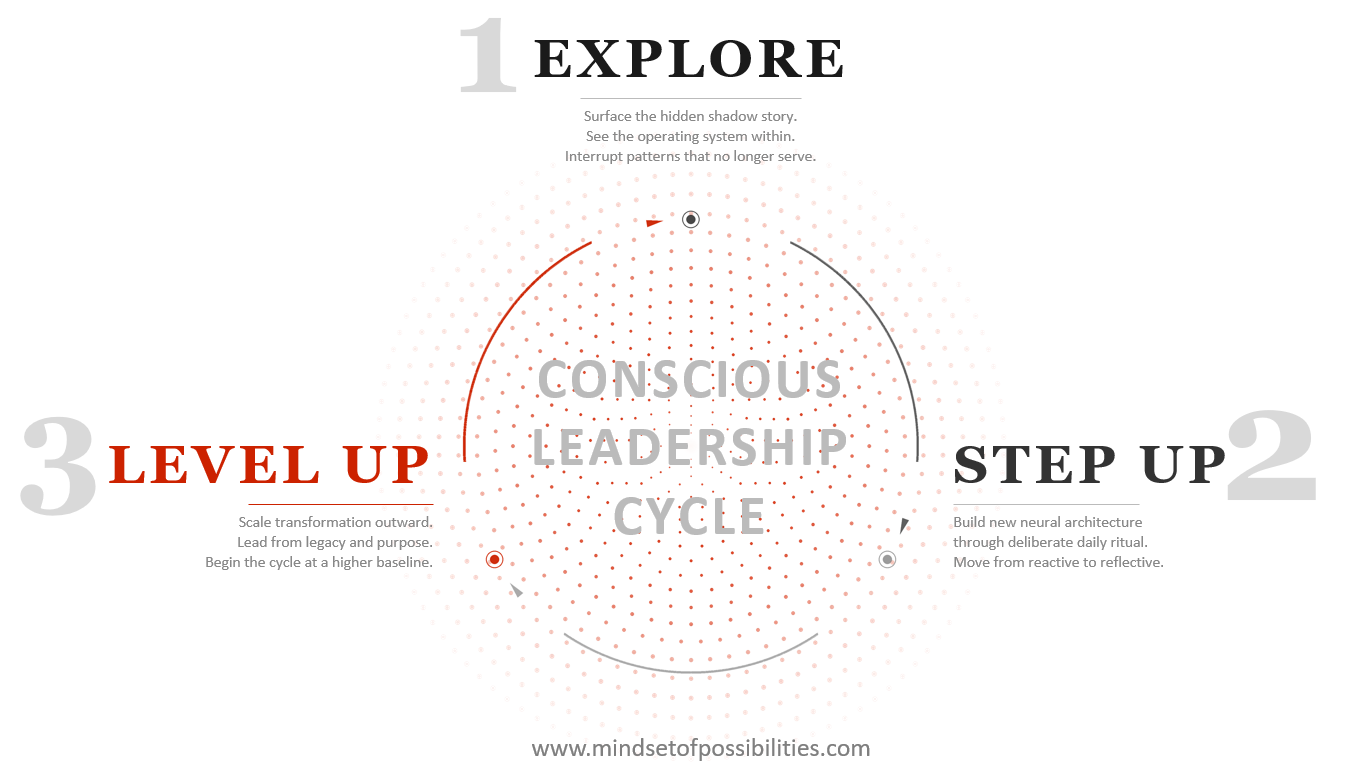
Figure 1. The three-step conscious leadership cycle of the Mindset of Possibilities System
5.1 Explore: Seeing What Has Been Invisible
The Explore step requires leaders to turn the same rigorous attention they typically devote to external problems inward, toward their own cognitive and emotional patterns. It is the step that most leadership development frameworks overlook because it is both the most personally demanding and the most strategically essential.
During Explore, leaders examine in real time their beliefs about themselves, their organizations, and the AI Era. They surface the hidden shadow story that has been running their decisions without their awareness by identifying the triggers, default responses, and emotional signatures when the old operating system fires. A leader who cannot see their own patterns is unable to change them. A leader who can recognize them has already begun their transformation.
5.2 Step Up: Building New Neural Architecture Through Daily Ritual
Understanding a pattern is a necessary condition for transformation, but it is not sufficient. The neural pathways that support habitual responses are strong because they have been reinforced repeatedly over time. Interrupting them and constructing alternatives requires equally consistent and deliberate practice (Doidge 2007).
The Step Up phase is organized around daily rituals: small, specific, repeatable practices that create the conditions for new neural pathways to form. These deliberate fifteen-minute daily engagements incorporate targeted questions, intentional behaviors, and reflective exercises designed to engage the prefrontal cortex, where the limbic system has previously operated on autopilot.
The rituals of Step Up focus on three specific shifts. The first is moving from reactive to reflective decision-making by creating a deliberate pause between trigger and response. The second is developing structured feedback loops that encourage leaders to receive and integrate information their previous operating system might have filtered out. The third is embodiment practice: intentionally rehearsing the behaviors of the leader one is becoming until those behaviors become the new default.
5.3 Level Up: Scaling Transformation Across Teams and Systems
Level Up is the phase in which a leader’s personal transformation begins to function as an organizational signal. The mirror neuron system ensures that the changes a leader has made in their own cognitive and emotional patterns are transmitted to those around them, creating the conditions for broader cultural evolution. The leader’s inner work becomes the organization’s permission to change.
In Level Up, leaders focus on their legacy: the culture they are creating, the decisions they are making, and the future they are actively designing. They use the awareness and practices developed in Explore and Step Up to make deliberate choices about the organizational narratives they amplify, the behaviors they model, and the conditions they create for others to transform alongside them.
The cycle then begins again from a higher baseline. Each pass through Explore, Step Up, and Level Up generates deeper awareness, stronger practices, and greater organizational capacity. Transformation is not a destination but a discipline, sustained through the same kind of deliberate practice that produces excellence in any complex domain.
6. The Framework and the 70%
The organizations achieving measurable, sustained AI impact share a common characteristic: visible, committed, and psychologically prepared leadership (BCG 2024). The technology is available to nearly everyone. The differentiating variable is the quality of the leadership driving adoption, the capacity of executives to model curiosity, sustain momentum through uncertainty, hold teams accountable to learning, and make the organizational changes that AI deployment demands.
This is the precise gap that the Mindset of Possibilities System is designed to address. A leader who has completed the Explore step understands their own hidden shadow story and can therefore prevent it from distorting strategic AI decisions. A leader practicing the rituals of Step Up develops the daily habits that sustain transformation. A leader operating at Level Up creates the organizational culture in which AI adoption becomes a shared identity carried across all levels.
7. The Einstein Moment Is Now
In March 2026, two of the most accomplished chief executives in American business, Coca-Cola’s James Quincey and Walmart’s Doug McMillon, told CNBC that the AI wave had influenced their decisions to step down (CNBC 2026).
Quincey, who had served as CEO since 2017 and added more than $10 billion brands to Coca-Cola’s portfolio, was direct about what had shifted. “In a pre-AI mode, we made a lot of progress,” he said. “But now there’s a huge new shift coming along.” He concluded that it was time to pass the role to someone with the energy to carry the organization through a transformation he believed he could start but could not finish (CNBC 2026).
McMillon, who had led Walmart since 2014 and had spoken publicly about AI reshaping every job in the company, offered a parallel signal in December 2025 before handing the role to John Furner.
These are accomplished leaders whose tenures produced strong stock performance, growing market share, and operational execution at enormous scale. Their departures, however, send a different signal. They are saying, with unusual candor, that the capabilities required to lead organizations through AI-driven transformation differ from those that produced success in the previous era.
Two chief executives of iconic, multigenerational brands looked ahead and concluded that the capabilities that had built their success were not the same as those the next phase would demand. Stepping aside with that degree of candor is honorable. It is also one response when a leader concludes that someone else is better positioned to lead the next stage of transformation.
Poincaré and Hilbert reached a similar threshold in 1905 and could not release the framework they had spent their careers building. Quincey and McMillon, to their considerable credit, recognized the limits of the frameworks that had served them. This paper argues for a third path: leaders who undertake the daily inner work required to develop the capacity to lead through transformation.
The question for every leader reading this is which of those paths they are preparing for.
Einstein's breakthrough in the theory of relativity came because he was willing to cultivate a level of awareness that his contemporaries could not access while remaining attached to what they already knew. He practiced the beginner's mind. He asked, without the filter of established certainty, what if the universe worked differently than everyone assumed (Isaacson 2008)?
The leaders who will define the AI Era face an identical invitation. The tools, the data, and the strategic frameworks are available to nearly everyone. It’s not always easy to have the capacity to see beyond what you already know, to release the certainty that the old paradigm once provided, and to lead from a place of curiosity rather than protecting your expertise.
The Mindset of Possibilities System provides a structured path toward developing that capacity. It begins with recognizing that 95 percent of what drives leadership behavior is invisible until a leader chooses to look. It continues through the practice of interrupting the hidden shadow story and building new neural architecture through daily rituals. Finally, it scales through the mirror-neuron effect, as the leader's personal transformation radiates outward to reshape the culture, strategy, and the people around them.
The agentic AI market will reach $199 billion (Zoting 2025). The organizations leading it will be distinguished by the depth of their leaders’ inner transformation. Leaders who invest in that transformation now, through the daily practice of conscious leadership, will find that technology amplifies everything they have built. The leaders who deferred that work will find that technology amplifies everything they have yet to examine.
That is the Einstein Moment. For the leaders reading this, their moment begins now.
References
Bandura, A. 1997. Self-Efficacy: The Exercise of Control. Worth Publishers.
Bannister, R. 2004. The First Four Minutes. The History Press.
Barrett, L. F. 2021. Seven and a Half Lessons About the Brain: A Scientific Guide to Understanding Your Brain. First Mariner Books.
BCG. 2024. The Stairway to GenAI impact. Boston Consulting Group.
BCG 2025. “When Companies Struggle to Adopt AI, CEOs Must Step Up.” Boston Consulting Group. https://www.bcg.com/publications/2025/when-companies-struggle-to-adopt-ai-ceos-must-step-up.
Bedoni, D., and Twani, E. 2026. The Mindset of Possibilities Workbook for Executive Leaders of the AI Era. Relational Learning Inc. https://www.mindsetofpossibilities.com/store/p/mops-workbook-for-executive-leaders-of-the-ai-era
Berger, W. 2016. A Most Beautiful Question. Bloomsbury USA.
Carroll, S. M. 2019. Something Deeply Hidden: Quantum Worlds and the Emergence of Spacetime. Dutton.
“Chronological Listing of U.S. Men Who Have Broken the Coveted 4 Minute Mark in the Mile” 2025. Bring Back the Mile America’s Distance. https://bringbackthemile.com/history/sub_4_sub_430.
Cohen, J. D.; Miller, E. 2001.” An Integrative Theory of Prefrontal Cortex Function.” Annual Review of Neuroscience 24, 167–202. DOI: 10.1146/annurev.neuro.24.1.167. https://pubmed.ncbi.nlm.nih.gov/11283309/.
Dandapani. 2023. The Power of Unwavering Focus: Focus Your Mind, Find Joy, and Manifest Your Goals. Bantam Press.
Doidge, N. 2007. The Brain That Changes Itself: Stories of Personal Triumph from the Frontiers of Brain Science. Penguin Life.
Frith, C. 2007). Making Up the Mind: How the Brain Creates Our Mental World. Wiley-Blackwell.
Fu, Y., Wang, D., Liu, J., Wang, H., Wen, F., Chen, W., and Liu, Z. 2025. “The Shared Neural Substrates of Emotional Mimicry and Emotional Contagion: An Activation Likelihood Estimation Meta-Analysis and Meta-Analytic Connectivity Modeling Analysis. Social Cognitive and Affective Neuroscience 20 (1): nsaf091. https://doi.org/10.1093/scan/nsaf091.
Gliadkovskaya, A. 2023. “Most US Patients Don't Trust AI in Healthcare Settings, Feel Transparency Would Help, Carta Survey Finds.” Fierce Healthcare. https://www.fiercehealthcare.com/health-tech/most-americans-dont-trust-ai-healthcare-setting-carta-survey-finds.
Hutchinson, J. B., and Barrett, L. F. 2019. “The Power of Predictions: An Emerging Paradigm for Psychological Research.” Current Directions in Psychological Science 28 (3): 280–291.
Isaacson, W. 2008. Einstein: His Life and Universe. Simon & Schuster.
Isaacson, W. 2011. Steve Jobs. Simon & Schuster.
Kahneman, D. 2013. Thinking, Fast and Slow. Farrar, Straus and Giroux.
Krueger, MD, D. 2026. Hard Work Miracle Playbook. Europe Books.
Krueger, D., MD. 2012. Outsmart Your Brain: An Instruction Manual. MentorPath.
Krueger, D. 2019. Your New Money Story: The Beliefs, Behaviors, and Brain Science to Rewire for Wealth. Rowman & Littlefield Publishers.
Langer, E. J. 2014. Mindfulness (25th Anniversary Edition). Balance.
McGovern, H. T., et al. 2024. “Priors and Prejudice: Hierarchical Predictive Processing in Intergroup Perception.” Frontiers in Psychology 15. https://doi.org/10.3389/fpsyg.2024.1386370.
Morris, M. 2024. “Satya Nadella Returned Microsoft to the Top by Showing Humility as CEO.” Fortune. https://fortune.com/2024/09/30/microsoft-ceo-satya-nadella-leadership-success-humility-culture-change/.
Nadella, S., Nichols, J. T., and Shaw, G. 2019. Hit Refresh: The Quest to Rediscover Microsoft's Soul and Imagine a Better Future for Everyone. Harper Business.
Neelakandan, L. 2026. “Major Outgoing CEOs Are Citing AI as a Factor in Their Decisions to Step Down.” CNBC. https://www.cnbc.com/2026/03/26/coca-cola-james-quincey-walmart-doug-mcmillon-artificial-intelligence-step-down.html.
Newsweek. 2024. “World's Best Hospitals 2024.” Newsweek. https://rankings.newsweek.com/worlds-best-hospitals-2024.
Rizzolatti, G., Sinigaglia, C., and Andersen, F. 2023. Mirrors in the Brain: How Our Minds Share Actions and Emotions. Oxford University Press. https://academic.oup.com/book/52927.
Saini, K. 2025. “Satya Nadella Tells Microsoft Staff to Embrace AI or Leave.” Final Round AI. https://www.finalroundai.com/blog/satya-nadella-ai-push-microsoft.
Sohail, S. H. 2023. “3 in 4 Patients Don’t Trust AI in Healthcare Setting.” HIT Consultant. https://hitconsultant.net/2023/10/24/3-in-4-patients-dont-trust-ai-in-healthcare-setting/.
Sun, Y., Yu, N., Chen, G., Liu, T., Wen, S., and Chen, W. 2025. “What Else Is Happening to the Mirror Neurons? A Bibliometric Analysis of Mirror Neuron Research Trends and Future Directions (1996–2024).” Brain and Behavior 15 (4): e70486. https://doi.org/10.1002/brb3.70486.
Suzuki, S. 2020. Zen Mind, Beginner's Mind: Informal Talks on Zen Meditation and Practice (50th Anniversary Ed.). Shambhala.
Vera, J. A. 2026. “Mayo Clinic’s 2025 Performance Advances Its Patient-Centered Mission.” Mayo Clinic News Network. https://newsnetwork.mayoclinic.org/discussion/mayo-clinics-2025-performance-advances-its-patient-centered-mission/.
Wang, D., Liu, C., and Chen, W. 2024. “The Role of Self-Representation in Emotional Contagion.” Frontiers in Human Neuroscience 18, 1361368. https://doi.org/10.3389/fnhum.2024.1361368.
Warren, T. 2025. “Satya Nadella Is Haunted at the Prospect of Microsoft Not Surviving the AI Era.” The Verge. https://www.theverge.com/tech/780946/microsoft-satya-nadella-town-hall-comments-ai-era-notepad.
Zoting, S. 2025. “Agentic AI Market Size, Share, and Trends 2025 to 2034.” Precedence Research. https://www.precedenceresearch.com/agentic-ai-market.